Although English grammar has a reputation for hiding banana peels under perfectly ordinary sentences, the word although is easier to master than it first appears. This useful conjunction helps writers connect two contrasting ideas, show an unexpected result, or acknowledge a fact without allowing it to derail the main point.
For example, compare “The restaurant was crowded” with “We found a table.” Both statements are clear, but the relationship between them is missing. Add although, and the contrast becomes obvious: “Although the restaurant was crowded, we found a table.” Suddenly, the sentence has logic, movement, and a tiny success story involving dinner.
This guide explains how to use although in a sentence through 10 practical steps, complete with punctuation rules, sentence patterns, common mistakes, and original examples.
What Does “Although” Mean?
Although means “in spite of the fact that” or “even though.” It is used when one fact contrasts with another fact or makes the outcome seem surprising. Grammatically, it is a subordinating conjunction, which means it introduces a dependent clause and connects that clause to a complete main clause.
Consider this sentence:
Although Maya was nervous, she delivered an excellent presentation.
The first idea tells us that Maya was nervous. The second tells us that she performed well. These ideas contrast because nervousness might normally lead to a poor presentation. The word although warns the reader that reality is about to ignore the obvious prediction.
The Basic Sentence Patterns
You can place the although clause before or after the main clause:
Pattern 1: Although + dependent clause, main clause.
Although the instructions looked complicated, the project was easy.
Pattern 2: Main clause + although + dependent clause.
The project was easy, although the instructions looked complicated.
In both versions, the sentence expresses the same basic contrast. The order changes which idea the writer presents first and may slightly shift the emphasis.
How to Use Although in a Sentence in 10 Steps
Step 1: Find Two Ideas That Genuinely Contrast
Before inserting although, identify two facts that create tension, surprise, or opposition. The word is not a decorative ribbon that can be tied around any pair of statements. The ideas must have a meaningful contrast.
Good contrast:
Although the weather was freezing, the children played outside.
Weak or illogical contrast:
Although the weather was freezing, the thermometer showed a low temperature.
The second example is awkward because both ideas describe the same situation. A low thermometer reading is expected when the weather is freezing. There is no surprise for although to introduce.
A useful test is to ask, “Would a reader normally expect the second fact after hearing the first?” When the answer is no, although may be an excellent choice.
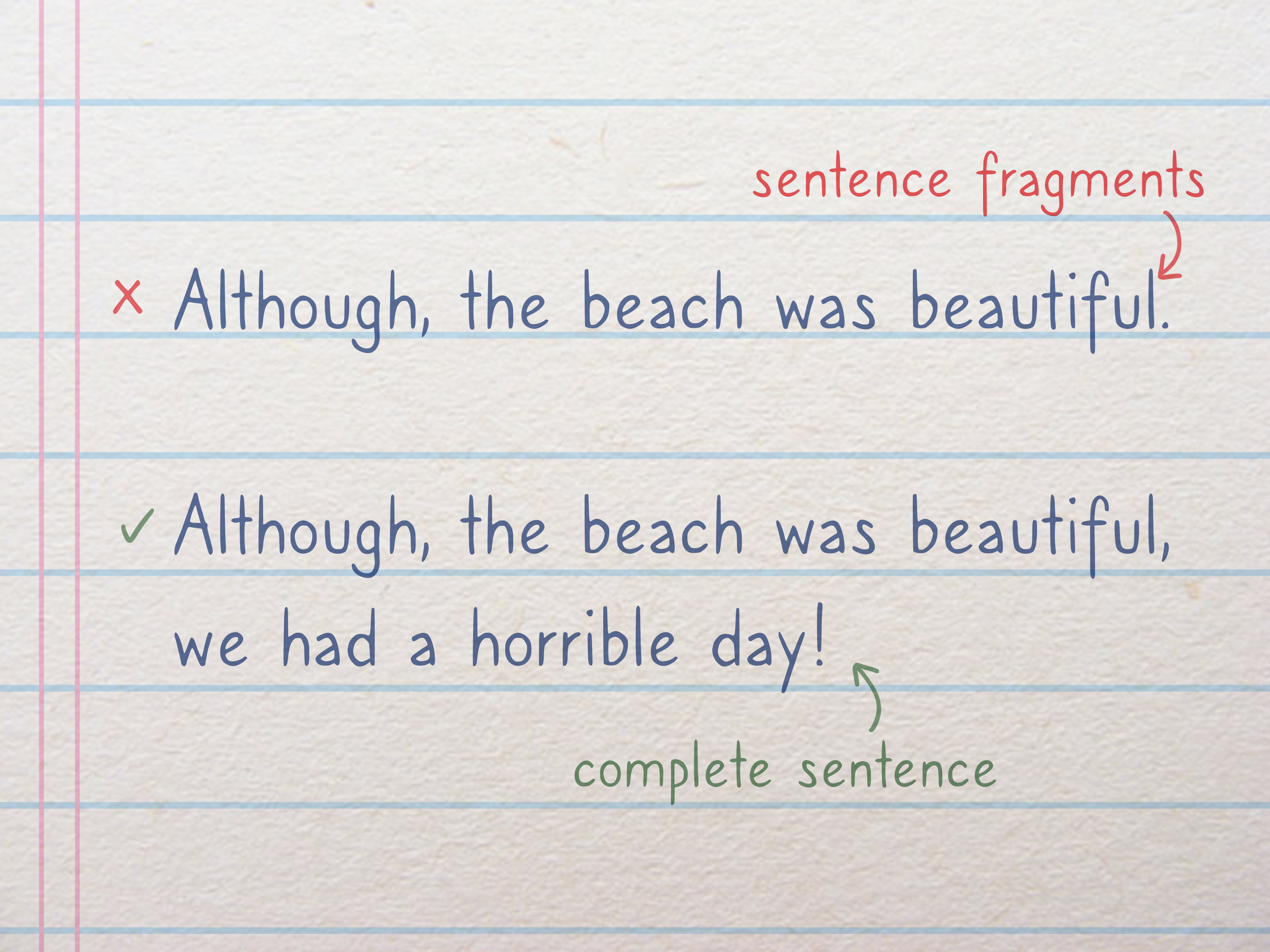
Step 2: Put a Complete Clause After “Although”
In its standard form, although should introduce a clause containing a subject and a verb. The clause becomes dependent, so it cannot normally stand alone as a complete sentence.
Correct:
Although the car is old, it still runs smoothly.
In “the car is old,” car is the subject and is is the verb.
Incorrect:
Although the old car.
This group of words has no complete verb and expresses no finished thought. Writing centers commonly classify clauses beginning with subordinating conjunctions as dependent clauses that must be attached to independent clauses.
A complete correction would be:
Although the car is old, it remains dependable.
Step 3: Decide Which Idea Deserves the Emphasis
Choose the order of the clauses based on what you want readers to notice. Beginning with although prepares readers for a contrast and places the main emphasis on the independent clause that follows.
Although Daniel lacked experience, the company hired him.
The surprising and important information is that the company hired Daniel.
Placing the main clause first can make the second idea feel like a qualification or afterthought:
The company hired Daniel, although he lacked experience.
Neither order is automatically better. The best arrangement depends on the surrounding paragraph and the point you want to emphasize.
Step 4: Use a Comma After an Introductory “Although” Clause
When an although clause begins a sentence, place a comma at the end of that dependent clause. The comma separates the introductory background from the main statement.
Correct:
Although the line was long, we decided to wait.
Incorrect:
Although the line was long we decided to wait.
The missing comma may not make the second version impossible to understand, but it ignores the standard punctuation pattern for an introductory dependent clause. Purdue OWL and several university writing resources recommend separating an introductory subordinate clause from the main clause with a comma.
Step 5: Consider a Comma When the “Although” Clause Comes Second
When the main clause comes first, punctuation can depend on meaning and editorial style. Many sentences use a comma before a following although clause because the clause introduces a noticeable contrast:
The apartment is comfortable, although the kitchen is tiny.
In some tightly connected constructions, writers omit the comma:
We continued walking although it had begun to rain.
However, a comma is often helpful when the contrast is strong, the clauses are long, or the reader might briefly misunderstand the sentence. Some educational grammar references treat concessive clauses beginning with although as more likely to take a comma in final position than ordinary dependent clauses beginning with words such as because.
When in doubt, prioritize clarity and follow the style guide required by your school, employer, or publication.
Step 6: Do Not Pair “Although” With “But”
One of the most common mistakes is using although and but to perform the same job in one sentence.
Incorrect:
Although the tickets were expensive, but we bought them.
Correct with “although”:
Although the tickets were expensive, we bought them.
Correct with “but”:
The tickets were expensive, but we bought them.
Although subordinates one clause, while but coordinates two grammatically equal elements. Both can express contrast, but their sentence structures are different. Using both together is redundant, like wearing a belt and suspenders and then gluing your pants to your waist.
Step 7: Know the Difference Between “Although,” “Though,” and “Even Though”
Although, though, and even though can all introduce contrasting clauses, but they differ slightly in tone and emphasis.
Although is neutral and works well in formal or general writing:
Although the proposal has weaknesses, it offers several useful ideas.
Though is often more conversational:
Though I was tired, I joined them for dinner.
Unlike although, though may also appear at the end of an informal sentence:
The movie was entertaining. It was far too long, though.
Even though creates a stronger or more surprising contrast:
Even though the alarm was extremely loud, Marcus slept through it.
Major dictionaries and grammar references describe even though as a more emphatic alternative, while though has informal and adverbial uses that although does not share.
Step 8: Do Not Confuse “Although” With “Despite”
Although is followed by a clause, while despite and in spite of are normally followed by a noun, pronoun, or gerund phrase.
With a clause:
Although the roads were icy, the buses continued running.
With a noun phrase:
Despite the icy roads, the buses continued running.
Incorrect:
Although the icy roads, the buses continued running.
You can also use despite the fact that before a clause, although this structure is longer:
Despite the fact that the roads were icy, the buses continued running.
For most everyday sentences, choose the shorter construction that fits the grammar naturally.
Step 9: Use Reduced “Although” Clauses Carefully
In polished or formal writing, an although clause may sometimes be shortened when its missing subject is clearly the same as the subject of the main clause.
Full clause:
Although Serena was disappointed, she congratulated the winner.
Reduced clause:
Although disappointed, Serena congratulated the winner.
Other natural patterns include:
Although inexperienced, the new employee learned quickly.
Although built decades ago, the bridge remains structurally sound.
The solution, although imperfect, reduced the immediate risk.
Do not reduce the clause when the implied subject would be confusing or illogical.
Confusing:
Although raining heavily, we continued the picnic.
This sentence accidentally suggests that we were raining. A clearer version is:
Although it was raining heavily, we continued the picnic.
Step 10: Read the Sentence for Logic, Rhythm, and Completeness
After writing the sentence, perform three quick checks:
- Logic: Do the two ideas truly contrast?
- Grammar: Is the dependent clause connected to a complete main clause?
- Punctuation: Is there a comma after an introductory although clause?
Reading the sentence aloud can reveal problems that remain invisible on the screen. If you naturally pause after the introductory clause, the comma belongs there. If the sentence ends after the dependent clause and leaves you wondering, “Yes, although what?” it is probably a fragment.
Writers should also avoid using although repeatedly in one paragraph. Alternatives such as but, yet, however, despite, while, and nevertheless can provide variety, although each alternative has its own grammatical requirements. Academic writing resources commonly group although with contrast or concession transitions rather than treating it as interchangeable with every contrast word.
Common Mistakes When Using “Although”
Leaving the Dependent Clause as a Fragment
Incorrect: Although we arrived before noon.
Correct: Although we arrived before noon, the best seats were already taken.
Creating a Redundant Contrast
Incorrect: Although the answer was obvious, but nobody responded.
Correct: Although the answer was obvious, nobody responded.
Following “Although” With Only a Noun
Incorrect: Although the heavy traffic, we arrived on time.
Correct: Although traffic was heavy, we arrived on time.
Also correct: Despite the heavy traffic, we arrived on time.
Using “Although” Without a Real Contrast
Awkward: Although the store was closed, we could not enter it.
Better: Although the store was closed, an employee allowed us to collect our order.
Forgetting the Introductory Comma
Incorrect: Although I had set two alarms I overslept.
Correct: Although I had set two alarms, I overslept.
More Examples of “Although” in Different Contexts
Everyday Conversation
Although I do not drink much coffee, I love the smell of it.
We enjoyed the beach, although the water was colder than expected.
Academic Writing
Although the study included a limited sample, its findings raise important questions.
The two theories share several assumptions, although their conclusions differ substantially.
Business Writing
Although sales declined in April, customer retention remained strong.
The campaign produced encouraging results, although further testing is necessary.
Creative Writing
Although the house appeared empty, music drifted from an upstairs window.
The old dog followed her into the forest, although every trembling step seemed to warn him against it.
Experience-Based Lessons for Mastering “Although”
Learning the definition of although usually takes a minute. Learning to use it naturally takes repetition. A common learner experience begins with overuse. Once students discover that although makes sentences sound more sophisticated, they may place it everywhere: although the bus arrived, although breakfast tasted good, although Tuesday continued to be Tuesday. The cure is not memorizing another rule. It is learning to notice genuine contrast.
One effective practice experience is combining pairs of simple sentences. Start with “The test was difficult. Nina earned a high score.” The contrast is obvious, so the sentences combine naturally: “Although the test was difficult, Nina earned a high score.” Next, try “The test was difficult. Several questions covered advanced material.” These ideas are related, but they are not opposites. Combining them with because may make more sense than using although. This comparison trains the writer to choose conjunctions by meaning rather than appearance.
Another useful experience involves moving the dependent clause. Write “Although the hotel was inexpensive, the rooms were spotless.” Then reverse it: “The rooms were spotless, although the hotel was inexpensive.” Reading both versions aloud helps reveal how sentence order controls emphasis. In the first version, the clean rooms feel like the important surprise. In the second, the low price feels like a qualifying detail added after the main statement.
Punctuation also becomes easier through visual habits. Writers can underline the complete main clause and circle the clause beginning with although. When the circled clause appears first, a comma should follow it. This simple marking exercise is especially helpful for people who find grammar terminology about as inviting as an instruction manual for assembling a submarine.
Editing real paragraphs offers another valuable lesson. Search a draft for every use of although. Check whether each sentence contains a true contrast, a complete main clause, and correct punctuation. Then look for repetition. Three sentences beginning with “Although” may all be grammatical, yet the paragraph can sound mechanical. Revising one with but, another with despite, and leaving the strongest one unchanged creates a more natural rhythm.
It is also helpful to keep a small correction log. Record mistakes such as “although + but,” missing introductory commas, or using although before a noun phrase. Beside each mistake, write one corrected example. After several days, patterns become clear. Many learners discover that they are not making twenty different errors; they are making the same two errors while wearing different hats.
Finally, practice with sentences from daily life. Write about work, meals, traffic, hobbies, or family plans: “Although the meeting ended late, I finished my report,” or “I tried the recipe, although I had never baked bread before.” Familiar subjects reduce the mental workload, allowing attention to remain on structure. Although mastery does not arrive after one worksheet, consistent practice turns the word from a grammar puzzle into an ordinary and dependable writing tool.
Conclusion
To use although correctly, connect two genuinely contrasting ideas and place the word at the beginning of the dependent clause. Include a complete main clause, add a comma after an introductory although clause, and avoid combining although with but. Remember that although normally introduces a subject-and-verb clause, while despite usually introduces a noun or noun phrase.
Once these patterns become familiar, although can improve essays, emails, reports, stories, and everyday communication. Although the rules may seem fussy at first, they quickly become automaticand yes, that sentence was waiting patiently for its moment.