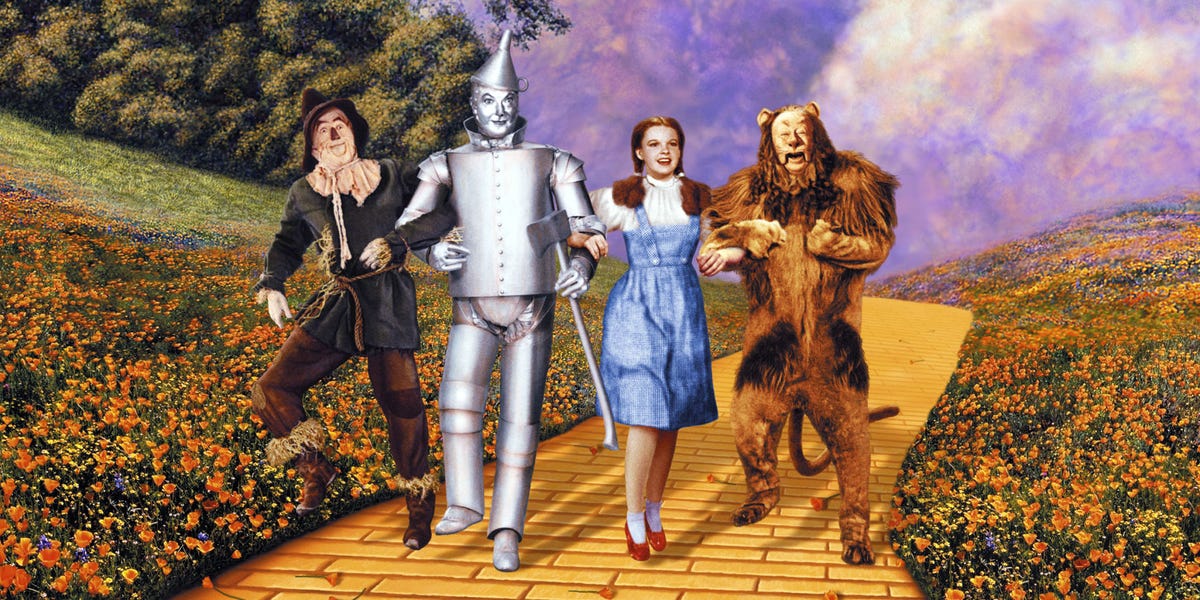
The Wizard of Oz has tornadoes, talking scarecrows, flying monkeys, sparkling shoes, and one extremely questionable wizard. Yet the story behind the 1939 movie is almost as remarkable as Dorothy’s journey through Oz. Its production involved abandoned footage, multiple directors, hazardous makeup, ingenious practical effects, and a song that studio executives nearly removed.
Here are 34 surprising Wizard of Oz facts and pieces of movie trivia, including the real stories behind several legends that have followed the film for decades.
From L. Frank Baum’s Book to MGM’s Blockbuster
1. The story began nearly four decades before the movie
L. Frank Baum published The Wonderful Wizard of Oz in 1900. Its distinctly American heroine, conversational storytelling, and imaginative characters helped distinguish it from the European fairy tales then dominating children’s literature.
2. Baum wrote 13 more Oz novels
The first book was not a one-tornado event. Baum ultimately produced 14 Oz novels, while other authorized writers continued the series after his death. The world surrounding Dorothy was therefore much larger than the portion MGM adapted.
3. The 1939 movie was not the first Oz adaptation
The story reached the stage in 1902 and appeared in silent films released in 1910 and 1925. The 1925 version even featured Oliver Hardy, years before he became internationally famous as half of Laurel and Hardy.
4. Snow White helped persuade Hollywood to return to Oz
Fantasy films were considered risky during the 1930s. The enormous success of Disney’s Snow White and the Seven Dwarfs in 1937 proved that audiences would enthusiastically support an expensive family fantasy, encouraging MGM to follow its own yellow brick road.
5. The movie rights changed hands at a handsome profit
Producer Samuel Goldwyn reportedly paid $40,000 for the film rights before MGM acquired them for $75,000 in 1938. That was a profitable trip to Oz for Goldwyn, and he did not even need to fight a witch.
6. Shirley Temple was considered for Dorothy
MGM initially hoped to borrow Shirley Temple from 20th Century Fox. Deanna Durbin was also discussed, but Judy Garland’s exceptional singing voice and successful screen test eventually secured the role.
7. Judy Garland was 16 during production
Garland was older than Baum’s child heroine, so costumes and styling were used to make her appear younger. During an early production shutdown, director George Cukor also eliminated a blonde wig and heavy glamour makeup, encouraging a more natural performance.
8. Ten writers worked on the screenplay
Noel Langley, Florence Ryerson, and Edgar Allan Woolf received the main screenplay credits, but at least 10 writers were assigned to the project in various capacities. That included Herman J. Mankiewicz, who later co-wrote Citizen Kane.
9. Four directors contributed to the production
Richard Thorpe began filming but was dismissed after MGM disliked the early footage. George Cukor briefly advised the production, Victor Fleming directed most of the finished movie, and King Vidor completed the remaining work after Fleming left for Gone with the Wind.
10. King Vidor directed the Kansas material
Although Victor Fleming received the sole directing credit, cinematography histories identify Vidor as the director of the Kansas scenes, including Dorothy’s performance of “Over the Rainbow.” Vidor kept quiet about his contribution for years because Fleming was his friend.
Casting, Costumes, and Dangerous Makeup
11. Ray Bolger fought to play the Scarecrow
Ray Bolger was initially assigned to the Tin Man, while Buddy Ebsen was cast as the Scarecrow. Bolger believed his loose-limbed dancing style was perfect for the straw-filled character and persuaded MGM to switch their roles.
12. The original Tin Man was hospitalized
Ebsen filmed as the Tin Man before becoming seriously ill from inhaling aluminum powder used in his makeup. His breathing became dangerously restricted, and he reportedly spent several weeks recovering in a hospital.
13. Jack Haley replaced Ebsen without being told the full story
Jack Haley stepped into the Tin Man role, and the makeup was changed from loose aluminum powder to a safer paste. Even that revised formula caused trouble, reportedly producing an eye infection.
14. The Wicked Witch’s green makeup contained copper
Margaret Hamilton’s famous green face was created with copper-based makeup. The pigment required careful handling because ingesting it could be dangerous, making meal breaks considerably less relaxing than a picnic in Munchkinland.
15. Margaret Hamilton suffered serious burns
Hamilton was supposed to disappear through a hidden elevator as flames and smoke erupted above her. During one take, the fire effect activated too early, burning her face and hand and forcing her to take an extended medical leave.
16. Hamilton’s stunt double was also injured
Stunt performer Betty Danko was hurt while riding the witch’s smoke-producing broomstick. A concealed pipe exploded, sending her to the hospital and leaving lasting scars. Early Hollywood special effects clearly operated under the rule “make it spectacular and hope everyone survives.”
17. The Cowardly Lion costume used real lion hide
Bert Lahr’s heavy costume was constructed partly from genuine lion pelts. Combined with facial appliances, studio lights, and energetic dance routines, it made playing the Cowardly Lion an exhausting physical performance rather than a leisurely afternoon of roaring.
18. The Technicolor sets became brutally hot
More than 150 powerful lights were reportedly used to produce the brightness required by early three-strip Technicolor photography. Temperatures climbed above 100 degrees, and crew members sometimes fainted or developed painful inflammation from the intense lights.
19. The Kansas scenes were not simply ordinary black-and-white footage
The opening and closing scenes were photographed on black-and-white film and printed using MGM’s Sepia Platinum process. This produced the warm, slightly dreamlike brown tone that contrasts so effectively with the saturated colors of Oz.
20. The transition into Oz required practical movie magic
Frames around the famous doorway transition were carefully treated and hand-painted to move the image from sepia into Technicolor. The result feels effortless, even though it depended on precise set design, laboratory work, and editing rather than a modern digital filter.
Ruby Slippers, Songs, and Special Effects
21. Dorothy’s slippers were silver in the book
Baum gave Dorothy silver shoes. MGM transformed them into ruby slippers because sparkling red sequins would create a stronger contrast against the Yellow Brick Road and demonstrate the vivid possibilities of Technicolor.
22. Several pairs of ruby slippers were produced
Multiple pairs were required for filming, rehearsals, close-ups, and stunt work. The Smithsonian’s National Museum of American History has displayed one surviving pair since acquiring it in 1979, turning movie footwear into a genuine national treasure.
23. One pair sold for $28 million
A pair stolen from the Judy Garland Museum in 2005 and recovered by the FBI in 2018 sold at auction in December 2024 for $28 million before fees. Apparently, the correct answer to “What would you pay to go home?” is “considerably more than expected.”
24. “Over the Rainbow” was nearly removed
MGM chief Louis B. Mayer reportedly threatened to cut the song, partly because executives worried that the quiet Kansas sequence slowed the movie. Producer Arthur Freed and others defended it, preserving what became Judy Garland’s signature number.
25. The movie won both major music Oscars
“Over the Rainbow,” composed by Harold Arlen with lyrics by E.Y. Harburg, won the Academy Award for Original Song. Herbert Stothart received the award for Original Score. Garland also received a special Juvenile Academy Award recognizing her performances that year.
26. An entire musical sequence was deleted
In the abandoned “Jitterbug” number, the Wicked Witch sent an insect to make Dorothy and her companions dance uncontrollably. The elaborate scene was cut to improve pacing and because executives feared the fashionable term “jitterbug” would quickly date the movie.
27. The tornado was a giant fabric funnel
Special-effects artist A. Arnold Gillespie created the twister using a roughly 35-foot muslin funnel reinforced with piano wire. It moved along a suspended track above a miniature farm while compressed air and clouds of dust added convincing chaos.
28. Frank Morgan played five different characters
Morgan portrayed Professor Marvel, the Wizard, the Emerald City gatekeeper, the carriage driver, and the palace guard. In other words, most of the authority figures Dorothy encounters are the same man wearing different hatswhich rather neatly summarizes the movie’s attitude toward authority.
29. Professor Marvel may have worn Baum’s old coat
The wardrobe department bought a worn Prince Albert coat for Morgan’s Professor Marvel costume. According to a production story supported by Baum’s widow and the original tailor, a label inside indicated that the jacket had once belonged to L. Frank Baum himself.
30. More than 100 performers played Munchkins
TCM records that 124 actors portrayed the residents of Munchkinland, including eight children used in background scenes. Their voices were frequently adjusted during post-production to create the unusual range of high and low vocal effects heard in the finished sequence.
31. Toto was a female dog named Terry
Dorothy’s supposedly male companion was played by a female Cairn Terrier. Terry reportedly earned $125 per week and appeared in several other movies. After the success of The Wizard of Oz, her name was officially changed to Toto.
Urban Legends and the Film’s Lasting Legacy
32. There is no hanging Munchkin in the background
A persistent urban legend claims that a Munchkin performer can be seen hanging from a tree during the forest sequence. Reviews of the footage and older film copies show a large bird moving in the background, not a concealed tragedy or later studio cover-up.
33. The famous asbestos-snow claim is disputed
Asbestos was commonly used in old film productions, and an asbestos version of the Scarecrow costume was reportedly employed for a fire scene. However, film historians have challenged the claim that the poppy-field snow itself was asbestos, identifying crushed gypsum as the likely material.
34. Television made the movie an American tradition
Despite positive attention and several Oscar nominations, the expensive production did not initially generate a major profit for MGM. Its 1956 network television premiere and recurring broadcasts introduced it to enormous family audiences, transforming a respected fantasy film into a shared cultural ritual.
Experiencing The Wizard of Oz Beyond the Trivia
One of the most rewarding ways to revisit The Wizard of Oz is to watch it first as a story and then again as a piece of handmade filmmaking. During the first viewing, the tornado, songs, witches, and Emerald City carry the adventure. During the second, the seams become part of the pleasure. Painted backdrops, miniature buildings, hidden wires, carefully timed trapdoors, and theatrical costumes reveal how much ingenuity was required to create a fantasy world without computer-generated imagery.
A family screening can also produce wonderfully different reactions. Younger viewers may treat the Wicked Witch and flying monkeys as nightmare fuel with excellent costumes. Adults are more likely to notice that Dorothy’s companions already possess the qualities they seek. The Scarecrow repeatedly develops plans, the Tin Man shows compassion, and the Lion acts despite his fear. The Wizard’s gifts do not create intelligence, love, or courage; they merely give each character permission to recognize what was already present.
Reading Baum’s novel after watching the movie creates another useful experience. Familiar landmarks remain, but the journey becomes stranger and more extensive. The shoes are silver, the Wicked Witch is less visually dominant, and several adventures omitted by MGM appear along the road. Comparing the two versions demonstrates how adaptation works: the film does not simply illustrate the book but reshapes it around music, visual parallels, and Dorothy’s dreamlike return to Kansas.
Movie trivia can also turn a rewatch into a small detective game. Look for Frank Morgan’s different disguises. Study how the image shifts from sepia to color. Notice the matte paintings surrounding the Emerald City and the physical performance beneath Ray Bolger’s Scarecrow costume. Watch the background bird responsible for the notorious hanging-Munchkin rumor. Once the myth is removed, the scene becomes less sinisterand considerably more ornithological.
For fans who enjoy film history, surviving artifacts provide another route into Oz. Dorothy’s slippers, Scarecrow costume pieces, early scripts, musical sketches, and other production materials have been preserved by institutions including the Smithsonian, the Academy, and the Library of Congress. Seeing these objects as physical itemsworn fabric, delicate sequins, handwritten lyricsmakes the movie feel less like an untouchable legend and more like the product of thousands of individual creative decisions.
The best experience, however, may remain the simplest: watching the film with someone encountering it for the first time. Few movies contain so many images that viewers recognize before they have actually seen the story. The Yellow Brick Road, ruby slippers, green witch, curtain, and repeated promise that home matters have escaped the boundaries of the screen. They now function as a shared vocabulary for ambition, deception, courage, friendship, and the uncomfortable realization that the solution may have been with us all along.
Conclusion
The Wizard of Oz survived a chaotic production, dangerous effects, changing directors, discarded scenes, and modest initial financial results. It later became one of the most widely recognized films in American history, joined the first group of movies selected for the National Film Registry in 1989, and gave popular culture some of its most durable songs, characters, quotations, and visual symbols.
The real movie trivia reveals something appropriate about Oz itself: behind the intimidating machinery was not a supernatural force but a collection of talented, imperfect people working frantically behind a curtain. Their methods were sometimes ingenious, sometimes hazardous, and occasionally bizarrebut the magic they created still works.
Note: Production stories that remain disputed have been identified as legends or qualified rather than presented as confirmed facts.