Dark basements, moonlit graveyards, and hallways with mysteriously broken lightbulbs have served horror movies well. Still, darkness is not mandatory. Some filmmakers prefer the harder challenge: frightening an audience beneath a cloudless sky, where every terrible detail is visible and nobody can blame the suspicious noise on a shadow.
The best daytime horror movies turn sunshine into a trap. Beaches become feeding grounds, summer festivals become nightmares, and ordinary country roads lead directly to families who would not pass even the most relaxed neighborhood background check. Instead of concealing danger, daylight exposes itand somehow makes escape feel even less likely.
The following movies are not necessarily set exclusively between breakfast and sunset. A few contain important nighttime scenes. However, their plots, signature scares, or longest stretches of tension unfold primarily in broad daylight. Here are ten horror movies that prove the sun is perfectly capable of ruining your day.
Why Horror in Broad Daylight Feels So Uncomfortable
Nighttime gives viewers an excuse to feel afraid. We cannot see what is hiding behind the door, beneath the bed, or inside the woods. Daylight removes that excuse. When a horror movie presents danger under bright natural light, it violates the comforting assumption that daytime is safe.
Daylight horror also gives filmmakers nowhere to hide. Disturbing makeup, threatening landscapes, and acts of violence must remain convincing when clearly visible. The audience can study the danger instead of merely imagining it. That clarity often creates a different kind of fear: not panic about what might be nearby, but dread caused by knowing exactly what is coming.
10 Terrifying Horror Movies Set Mostly During the Day
1. Midsommar (2019)
Ari Aster’s Midsommar is the modern poster child for horror in broad daylight. Dani, played by Florence Pugh, travels to rural Sweden with her emotionally distant boyfriend and his friends. They expect folk traditions, unusual food, and perhaps a few aggressively educational flower crowns. Instead, they find themselves inside a community whose hospitality comes with an alarming number of ritual requirements.
Because the story takes place during a summer festival beneath the near-constant sun, darkness rarely arrives to offer visual relief. White clothing, green fields, painted buildings, and elaborate floral decorations make the setting look cheerful even as the customs become increasingly brutal.
The brightness is essential to the movie’s psychological effect. The visitors can see the warning signs, yet they repeatedly explain them away as cultural differences. Nothing is hidden. Their inability to accept the obvious becomes more frightening than any creature emerging from a closet.
2. The Wicker Man (1973)
Long before Midsommar handed audiences a complimentary cup of suspicious festival tea, Robin Hardy’s The Wicker Man demonstrated how effectively folk horror could operate in the sunshine.
Police Sergeant Neil Howie travels to the remote Scottish island of Summerisle to investigate the disappearance of a young girl. The residents claim she never existed, although they are not particularly talented at making their denials sound believable. As Howie investigates, he discovers a pagan community whose beliefs conflict with nearly everything he values.
Much of the film unfolds across green landscapes, village streets, classrooms, orchards, and public celebrations. The island does not resemble a haunted wasteland. It looks fertile, welcoming, and unusually enthusiastic about group singing.
That pleasant appearance is precisely the problem. Howie believes that law, logic, and moral certainty will protect him. The islanders understand that he is walking through a plan that began before he arrived. The sunlit setting makes his isolation painfully clear: everyone can see what is happening except the man investigating it.
3. Jaws (1975)
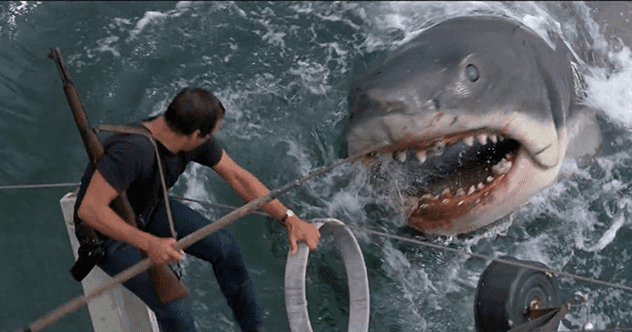
Jaws begins with a nighttime attack, but its defining terror belongs to crowded beaches, sparkling water, and sunny vacation weather. Steven Spielberg transformed an ordinary summer destination into a place where entering the water feels like volunteering for an extremely short swimming lesson.
After a great white shark attacks swimmers near Amity Island, Police Chief Martin Brody wants the beaches closed. Local officials resist because the town depends on summer tourism. Their financial optimism lasts considerably longer than their common sense.
The film’s daytime scenes make the threat especially effective. Families play in shallow water while Brody watches from the beach, scanning every splash and floating object. Spielberg repeatedly directs the audience’s attention toward the water without revealing whether the shark is actually present.
Later, Brody joins marine biologist Matt Hooper and shark hunter Quint aboard the Orca. Their hunt occurs largely beneath open skies, yet the ocean remains unreadable. Daylight illuminates the surface without revealing what is moving below it. That contrast helped make Jaws one of the most influential creature features ever made.
4. The Texas Chain Saw Massacre (1974)
Tobe Hooper’s The Texas Chain Saw Massacre feels less like a polished movie than footage recovered from the world’s worst road trip. A group of young travelers crosses rural Texas, picks up a deeply unsettling hitchhiker, and eventually discovers a farmhouse occupied by Leatherface and his cannibalistic family.
Although the final portion descends into nighttime chaos, much of the film’s menace develops beneath an oppressive afternoon sun. The dry landscape, abandoned structures, animal remains, and nearly empty roads create a sense of exhaustion before the central violence begins.
The heat is almost another character. Sweat, dust, buzzing insects, and harsh natural light make the experience feel physically unpleasant. Leatherface’s first appearance is particularly shocking because it occurs without supernatural buildup. A character enters the wrong house, a metal door opens, and the nightmare begins with the blunt efficiency of someone starting a household chore.
The daylight also supports the movie’s grim realism. This does not seem like a gothic legend occurring in a distant universe. It feels like something waiting several miles beyond a gas station where you should have asked for directions.
5. The Hills Have Eyes (1977)
Wes Craven’s original The Hills Have Eyes turns the American desert into a giant outdoor trap. The Carter family is traveling through the Southwest when their vehicle crashes after they ignore warnings and take an isolated route. Soon, they are targeted by a violent clan living among the surrounding hills.
Unlike horror settings filled with hiding places, the desert appears empty and exposed. The stranded family can see for miles, but visibility does not help them. Their attackers know how to use the rocks, slopes, and abandoned structures as cover.
The film also creates a disturbing mirror between two families. The Carters consider themselves civilized, while the desert clan appears savage. As the attacks escalate, survival forces the vacationers to become increasingly violent themselves. The blazing environment strips away comfort, privacy, and eventually social restraint.
Here, sunshine does not promise rescue. It produces dehydration, fatigue, and the growing realization that anyone coming to help would probably need directions nobody has.
6. Tremors (1990)
Tremors combines monster horror, western adventure, and comedy without allowing any one ingredient to eat the others. Most of the action takes place during the day in Perfection, Nevada, a tiny desert settlement with a population small enough that losing even one resident creates an immediate staffing problem.
Handymen Val McKee and Earl Bassett discover that enormous underground creatures are hunting people by detecting vibrations. Walking, running, or driving across the ground attracts them, forcing the survivors onto rooftops, rocks, vehicles, and anything else that cannot be swallowed from below.
The clear desert setting allows viewers to understand the geography of each sequence. We can see the distance between safety and danger, making every attempted escape easy to follow and wonderfully tense. A building may be only a few yards away, but crossing those yards is effectively ringing a dinner bell.
Daylight also helps the comedy. The characters can observe their ridiculous situation, argue about impractical plans, and improvise solutions using limited supplies. Tremors is scary without becoming joyless, making it an excellent daytime horror movie for viewers who like monsters served with personality.
7. The Ruins (2008)
Vacations in horror movies rarely improve after someone suggests visiting an obscure archaeological site. The Ruins follows a group of tourists in Mexico who travel to an isolated Mayan ruin and become trapped on top of it by armed locals.
The reason for the quarantine is even worse than expected. The ruin is covered by an intelligent, predatory vine capable of imitating sounds, entering wounds, and turning paranoia into a practical survival strategy.
Most of the ordeal occurs under relentless sunlight. The characters have limited water, almost no shelter, and no safe way to leave. The exposed setting makes the movie’s body horror difficult to avoid. Injuries must be examined and treated in full view, often with tools that would cause an experienced surgeon to quietly leave the room.
The environment also reverses a familiar horror rule. Plants usually represent life and natural beauty. In The Ruins, the greenery is the predator. The sunshine feeding the vines feels less comforting with every passing hour.
8. Who Can Kill a Child? (1976)
Narciso Ibáñez Serrador’s Spanish horror film Who Can Kill a Child? follows Tom and his pregnant wife, Evelyn, as they visit the fictional island of Almanzora. They expect a peaceful vacation but discover that most of the adults have disappeared. The remaining children behave cheerfully, which becomes much more disturbing once the couple learns what happened.
The movie unfolds through quiet streets, empty homes, coastal scenery, and sun-bleached public spaces. The children do not need darkness to appear threatening. Their calm expressions and playful behavior make the violence more unsettling because they do not seem angry or frightened. To them, the destruction of the island’s adults resembles a community game.
The title identifies the moral trap. Even after recognizing the danger, adults hesitate to defend themselves against children. The movie uses that hesitation to sustain tension while raising uncomfortable questions about innocence, responsibility, and whether moral rules can survive an impossible emergency.
Few films make a bright Mediterranean island feel so completely abandoned.
9. The Birds (1963)
Alfred Hitchcock’s The Birds takes creatures associated with parks, telephone wires, and minor windshield inconvenience and transforms them into an unexplained apocalyptic force.
Socialite Melanie Daniels follows attorney Mitch Brenner to Bodega Bay, where isolated bird attacks gradually grow into coordinated assaults. The film never offers a clear explanation for the behavior. There is no laboratory accident, magical curse, or villain delivering a helpful presentation about the plan.
Many of its most memorable attacks happen during the day. Crows silently gather outside a school while children sing inside. Gulls attack a crowded town. Birds descend on exposed roads and buildings as residents search for shelter.
The broad daylight makes the scale of the threat visible. One bird is manageable. Hundreds waiting with suspicious patience are another matter. Hitchcock also delays some attacks by allowing viewers to notice the gathering birds before the characters do. The result is suspense built not from darkness, but from watching a normal landscape become increasingly wrong.
10. Cujo (1983)
In Cujo, a friendly Saint Bernard contracts rabies and becomes a lethal threat. Donna Trenton and her young son, Tad, drive their unreliable Ford Pinto to a remote mechanic’s property. The car breaks down, Cujo appears, and their ordinary repair visit becomes a brutal siege.
The central conflict takes place largely inside a stationary car beneath the hot sun. Donna cannot safely reach the house, and driving away is impossible. Meanwhile, the temperature rises, water runs low, and Tad’s condition deteriorates.
The movie generates tension through painfully simple distances. Safety may be several seconds away, but Cujo can cross the same space much faster. Every attempt to open a door or roll down a window becomes a life-or-death calculation.
Unlike supernatural monsters, Cujo is an animal suffering from a real disease. That tragedy gives the film an uncomfortable emotional layer. The dog is terrifying, but he is not evil. The true horror comes from isolation, bad timing, mechanical failure, and the fact that nobody knows where Donna and Tad are.
What These Daytime Horror Movies Have in Common
These films use different monsters, locations, and storytelling styles, but several patterns connect them. Most place characters in open environments that create the illusion of freedom. A beach, island, desert, village, or country road appears easier to escape than a locked basement. The characters soon discover that exposure is not the same as mobility.
Daytime horror also favors social and environmental threats. The danger may be an entire community, an animal behaving unpredictably, an unforgiving climate, or a landscape controlled by someone who understands it better than the visitors do. Darkness is unnecessary because the characters are trapped by geography, disbelief, exhaustion, or other people.
Finally, these movies make ordinary daytime activities feel unsafe. Swimming, sightseeing, driving, hiking, attending a festival, and visiting a mechanic should not require a final will and testament. After watching these films, however, even a sunny vacation can seem like an elaborate opening scene.
Daylight Horror Viewing Experiences: How to Get More From These Movies
Watching a horror movie during the afternoon creates a surprisingly different experience from watching the same film late at night. You may feel more protected because sunlight is coming through the windows, other people are awake, and the refrigerator is only a short walk away. Daytime horror uses that confidence against you. The brightness on the screen begins to resemble the brightness in your room, reducing the psychological distance between the fictional danger and your surroundings.
A useful experiment is to watch one of these movies without darkening the room. Begin with a film whose location resembles somewhere familiar. Coastal viewers may find Jaws or The Birds particularly effective, while anyone who regularly drives through rural areas may develop an immediate and completely reasonable concern after The Texas Chain Saw Massacre. People planning a cheerful European festival vacation should probably watch Midsommar after buying nonrefundable tickets.
Pay attention to how each director uses distance. In nighttime horror, danger often enters the frame suddenly. In daylight horror, it may remain visible for several seconds. The schoolyard sequence in The Birds, the exposed crossings in Tremors, and the spaces surrounding Donna’s car in Cujo all let viewers calculate the risk. That calculation creates participation. You are not merely waiting for a surprise; you are mentally designing an escape plan that the movie will probably reject.
Sound is equally important. Bright images can appear safe, so filmmakers often use music, silence, animal noises, machinery, or repetitive community songs to create unease. The Wicker Man and Midsommar surround their protagonists with music and celebration. The cheerful atmosphere does not reduce the threat. It demonstrates that the people controlling the situation are having a much better time than their guests.
For a daytime horror marathon, begin with Tremors. Its humor and clear adventure structure make it an inviting first feature. Follow it with Jaws or The Birds, both of which gradually turn recognizable environments against their characters. Save the harsher materialsuch as The Ruins, The Hills Have Eyes, and The Texas Chain Saw Massacrefor later, when everyone has become comfortable and the snacks are no longer providing emotional support.
Finish with either The Wicker Man or Midsommar. The two films make an excellent thematic pairing because both involve outsiders entering isolated communities with unfamiliar beliefs. Watching them together highlights how folk horror evolved across generations while preserving the same essential warning: when an entire village invites you to participate in a special ceremony, ask whether guests are traditionally allowed to leave.
The most lasting experience may arrive after the credits. These films do not make viewers afraid only of darkness. They attach anxiety to specific daytime places and activities. A large dog near a disabled vehicle, birds gathering above a playground, or an unusually welcoming rural festival may suddenly deserve closer inspection. Sunshine returns, but innocence does not.
Conclusion
The finest horror movies that take place mostly during the day prove that fear does not depend on darkness. Brightness can expose danger, increase vulnerability, and transform ordinary landscapes into inescapable arenas.
Midsommar and The Wicker Man weaponize community traditions. Jaws, The Birds, and Cujo turn familiar animals into terrifying forces. Tremors, The Hills Have Eyes, and The Ruins make the environment itself part of the trap. Meanwhile, Who Can Kill a Child? and The Texas Chain Saw Massacre demonstrate that human behavior can remain horrifying under even the clearest sky.
The next time someone says a horror movie cannot be scary with the lights on, show them one of these films. Just do not schedule a beach trip, desert drive, island vacation, archaeological excursion, or flower festival immediately afterward.